
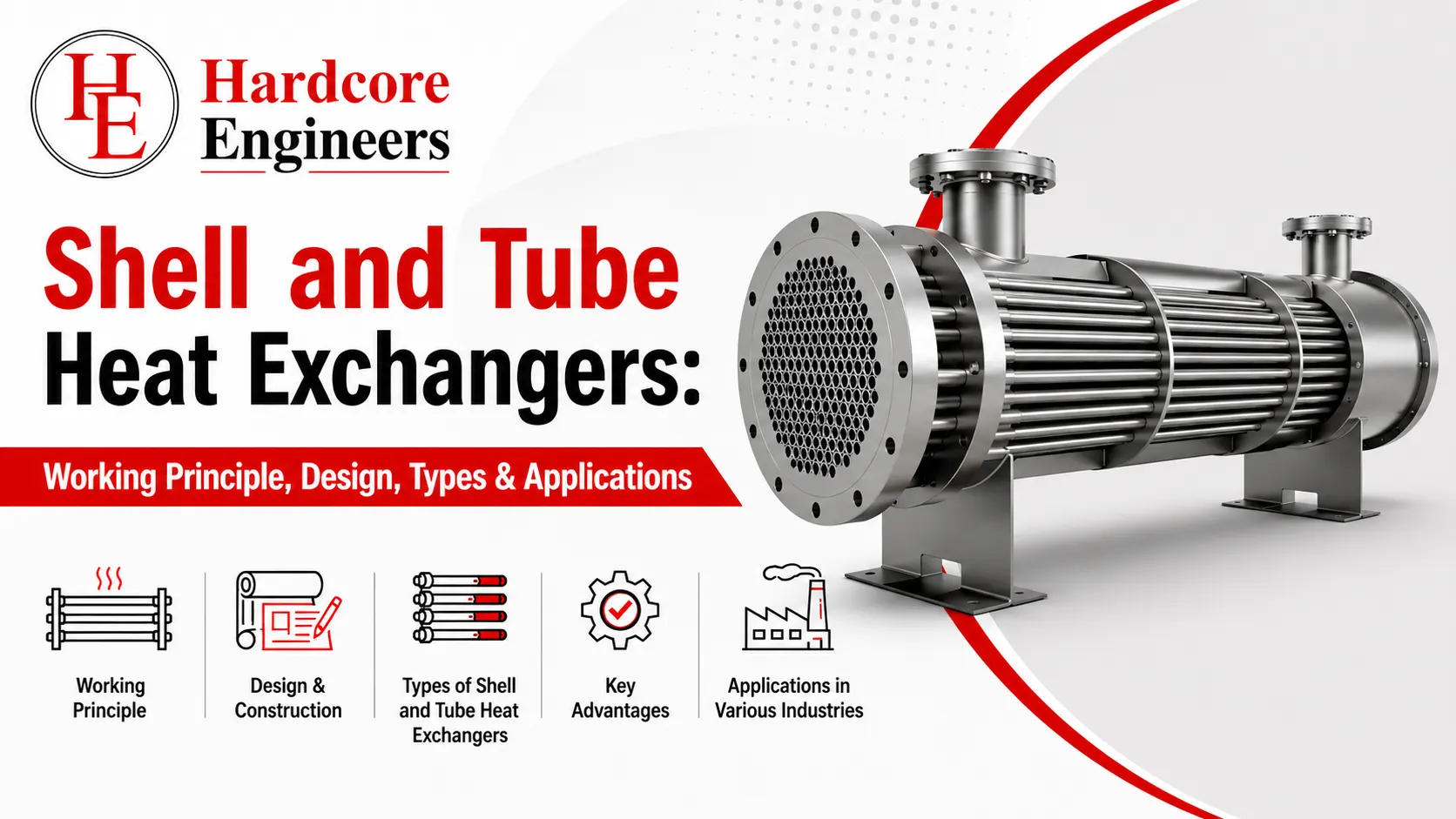
Heat exchangers are essential equipment in many industrial processes where heat transfer between two fluids is required. Among the various types of heat exchangers available, the Shell and Tube Heat Exchanger is one of the most widely used due to its efficiency, durability, and ability to handle high temperatures and pressures. These heat exchangers are commonly found in chemical plants, power generation facilities, oil refineries, pharmaceutical industries, food processing units, and HVAC systems.
What is a Shell and Tube Heat Exchanger?
A Shell and Tube Type Heat Exchanger is a device designed to transfer heat between two fluids without allowing them to mix. It consists of a bundle of tubes enclosed within a cylindrical shell. One fluid flows through the tubes, while the other fluid flows around the outside of the tubes within the shell.
The heat transfer occurs through the tube walls, enabling efficient exchange of thermal energy between the two fluids.
How Does a Shell and Tube Type Heat Exchanger Work?
A Shell and Tube Heat Exchanger works by transferring heat between two fluids without allowing them to mix. One fluid flows through the tubes, while the other flows around the outside of the tubes within the shell. As the fluids pass through the exchanger, heat is transferred through the tube walls from the hotter fluid to the cooler fluid.
Working Principle of Shell and Tube Heat Exchangers
The working principle is based on thermal energy transfer between two fluids at different temperatures.
Step 1: Fluid Entry
One fluid enters the tube side while the second fluid enters the shell side.
Step 2: Heat Transfer
As the fluids flow through the exchanger, heat passes through the tube walls from the hotter fluid to the cooler fluid.
Step 3: Temperature Change
The hot fluid loses heat while the cold fluid gains heat, achieving the desired temperature change.
Step 4: Fluid Exit
Both fluids leave the heat exchanger separately without mixing.
This design allows efficient heat transfer while maintaining complete separation between the two process fluids.
Types of Shell and Tube Heat Exchangers
Fixed Tube Sheet Heat Exchanger
In this design, both ends of the tubes are fixed to tube sheets.
Advantages:
- Simple construction
- Lower cost
- Suitable for clean fluids
Applications:
- Water cooling systems
- General industrial processes
U-Tube Heat Exchanger
The tubes are bent into a U-shape, allowing thermal expansion without causing stress.
Advantages:
- Handles temperature variations effectively
- Easy thermal expansion management
Applications:
- High-temperature services
- Chemical processing plants
Floating Head Heat Exchanger
One tube sheet remains fixed while the other can move freely.
Advantages:
- Easy maintenance
- Suitable for large temperature differences
Applications:
- Petroleum refineries
- Heavy industrial applications
Multi-Pass Heat Exchanger
The fluid passes through the tube bundle multiple times to increase heat transfer efficiency.
Advantages:
- Higher heat transfer rates
- Compact design
Applications:
- Process industries
- Power plants
Shell and Tube Heat Exchanger Design and Construction
A Shell and Tube Heat Exchanger consists of a cylindrical shell containing a bundle of tubes that facilitate heat transfer between two fluids without mixing them. Its main components include the shell, tubes, tube sheets, baffles, and channel covers. The design is engineered to maximize heat transfer efficiency while handling high temperatures and pressures. Manufactured using materials such as stainless steel and carbon steel, these heat exchangers are widely used in chemical, pharmaceutical, food processing, power generation, and oil & gas industries.
Main Components of a Shell and Tube Heat Exchanger
Shell
The shell is the outer cylindrical vessel that contains one of the fluids. It directs the flow around the tube bundle to maximize heat transfer.
Tube Bundle
A collection of tubes through which one of the fluids flows. The tube bundle provides a large surface area for efficient heat exchange.
Tube Sheets
Tube sheets securely hold the tubes in place and separate the shell-side and tube-side fluids.
Baffles
Baffles are installed inside the shell to direct fluid flow across the tubes, improving heat transfer efficiency and reducing dead zones.
Heads and Channels
These components distribute fluid into the tubes and collect it after it passes through the heat exchanger.
Advantages of Shell and Tube Heat Exchangers
- High Efficiency: The large heat transfer area ensures excellent thermal performance.
- Durable Construction: Designed to withstand high pressure and temperature conditions.
- Flexible Design: Available in numerous configurations for different applications.
- Easy Maintenance: Many designs allow tube bundle removal for inspection and cleaning.
- Suitable for Large Capacities: Can handle significant flow rates in industrial operations.
Long Service Life: Manufactured using high-quality materials for reliable long-term performance.
Applications of Shell and Tube Heat Exchangers
Chemical Industry
Used for heating, cooling, condensation, and evaporation processes.
Pharmaceutical Industry
Maintains controlled temperatures during drug manufacturing and processing.
Food and Beverage Industry
Supports pasteurization, sterilization, and temperature control operations.
Oil and Gas Industry
Used in refineries, petrochemical plants, and offshore processing facilities.
Power Generation Plants
Used in condensers, cooling systems, and heat recovery processes.
HVAC Systems
Provides heating and cooling for commercial and industrial buildings.
Marine Industry
Used for engine cooling and thermal management applications.
Hardcore Engineers – Trusted Heat Exchanger Manufacturer
Hardcore Engineers- Heat Exchanger Manufacturers offers customized heat exchanger solutions engineered to deliver efficient thermal performance, durability, and operational reliability. Our products are manufactured using premium materials and advanced engineering practices to meet the demanding requirements of industries such as chemicals, pharmaceuticals, food processing, power generation, and oil & gas.
With a commitment to quality, innovation, and customer satisfaction, Hardcore Engineers provides heat exchangers that help improve process efficiency, reduce energy consumption, and ensure long-term operational performance.
Conclusion
Shell and Tube Heat Exchangers remain one of the most versatile and widely used heat transfer solutions in industrial applications. Their robust construction, high efficiency, and ability to handle demanding operating conditions make them an ideal choice for various industries.
By understanding their working principle, types, and applications, businesses can select the most suitable heat exchanger for their specific needs.