Heat exchangers play a crucial role in maintaining indoor comfort, energy efficiency, and system reliability. Whether it is cooling commercial buildings, heating industrial spaces, or ensuring proper air handling, HVAC heat exchangers are the backbone of thermal energy transfer.
What Is an HVAC Heat Exchanger?
An HVAC heat exchanger is a device that transfers heat between two fluids—such as air, water, steam, or refrigerant—without allowing them to mix. The primary function of a heat exchanger is to either remove heat or supply heat, depending on HVAC system requirements.
In HVAC applications, heat exchangers are used for:
- Cooling hot air in air-conditioning systems
- Heating cold air in space heating systems
- Recovering waste heat to improve energy efficiency
Working Principle of HVAC Heat Exchangers
The working principle of an HVAC heat exchanger is based on thermal energy transfer through conduction and convection.
Step-by-Step Working Process:
- Hot Fluid Entry: A hot fluid (hot air, water, or refrigerant) enters the heat exchanger.
- Cold Fluid Flow: A cooler fluid flows on the opposite or adjacent side.
- Heat Transfer Surface: Heat transfers through metal surfaces such as tubes, fins, or plates.
- No Mixing of Fluids: The fluids remain separated while heat energy is exchanged.
- Temperature Regulation: The heated or cooled fluid is supplied to the HVAC system.
The efficiency depends on material quality, surface area, flow arrangement, and temperature difference.
Types of HVAC Heat Exchangers
Different HVAC systems require different heat exchanger designs based on capacity, space, and operating conditions.
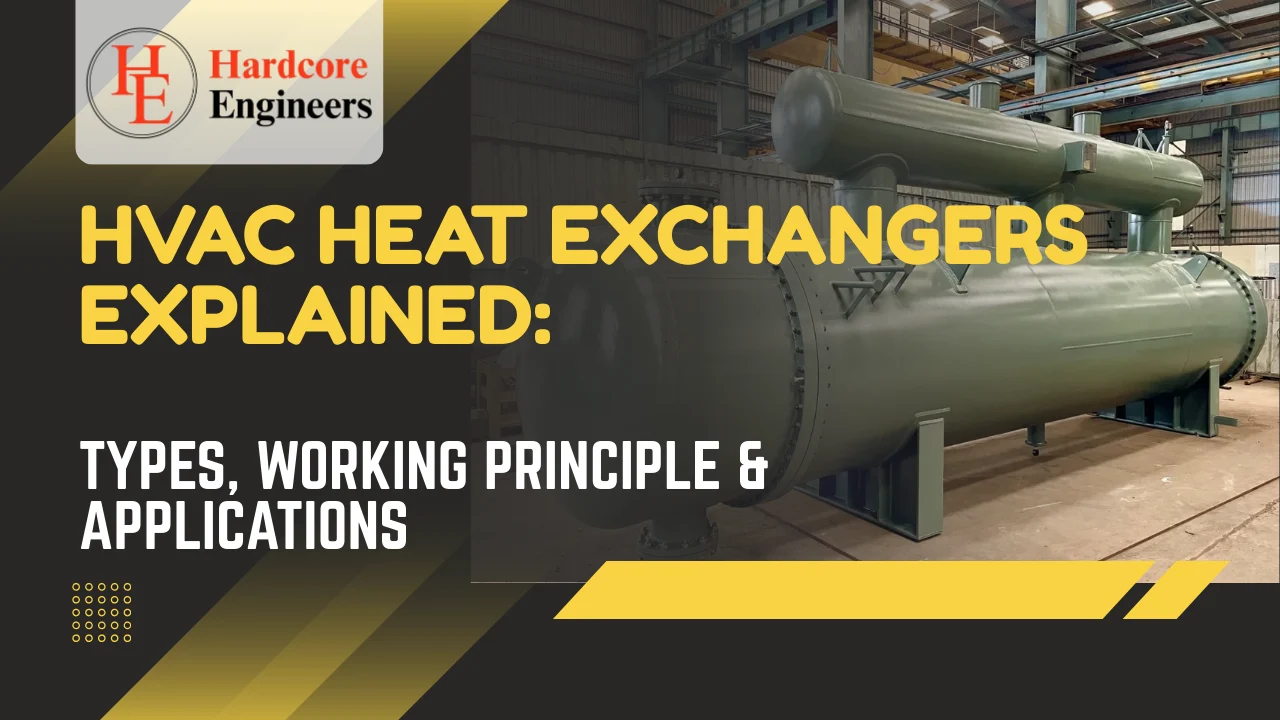
1. Shell and Tube Heat Exchanger
Shell and tube heat exchangers consist of a tube bundle enclosed within a cylindrical shell.
Key Features:
- Handles high pressure and temperature
- Robust and long-lasting construction
Applications:
- Chillers
- Boilers
- Industrial HVAC systems
2. Plate Heat Exchanger
Plate heat exchangers are made of multiple thin plates that create channels for fluid flow.
Key Features:
- Compact design
- High heat transfer efficiency
- Easy maintenance
Applications:
- District cooling
- Heat recovery systems
- Commercial HVAC installations
3. Finned Tube Heat Exchanger
This type uses fins attached to tubes to increase heat transfer surface area.
Key Features:
- Excellent air-side heat transfer
- Lightweight and efficient
Applications:
- Air Handling Units (AHUs)
- Fan coil units
- HVAC condensers and evaporators
4. Air-to-Air Heat Exchanger
Air-to-air heat exchangers recover energy from exhaust air to precondition fresh air.
Key Features:
- Energy recovery
- Reduced HVAC load
Applications:
- Ventilation systems
- Clean rooms
- Commercial buildings
5. Heating and Cooling Coils
These are commonly used in HVAC ducts and AHUs.
Key Features:
- Simple and efficient design
- Reliable temperature control
Applications:
- Central air-conditioning systems
- Commercial and industrial HVAC
Applications of HVAC Heat Exchangers
HVAC heat exchangers are widely used in:
- Commercial Buildings: Offices, malls, hotels, hospitals
- Industrial Facilities: Manufacturing units, pharmaceuticals, food processing plants
- HVAC Equipment: AHUs, chillers, boilers, fan coil units
- Energy Recovery Systems: Waste heat recovery and energy-efficient HVAC solutions
Benefits of HVAC Heat Exchangers
- Improved Energy Efficiency: Reduces heating and cooling energy demand
- Lower Operating Costs: Optimizes HVAC system performance
- Enhanced Indoor Comfort: Maintains stable temperature and airflow
- Environment Friendly: Reduces carbon emissions
- Long Service Life: Durable construction ensures reliability
Conclusion
HVAC heat exchangers are critical components that ensure efficient heating, cooling, and ventilation across modern HVAC systems. Understanding their types, working principles, and applications helps in selecting the right heat exchanger for optimal performance.
For reliable, efficient, and long-lasting HVAC heat exchangers, Hardcore Engineers stands out as a dependable heat exchanger manufacturer, delivering engineered solutions for today’s HVAC needs.