
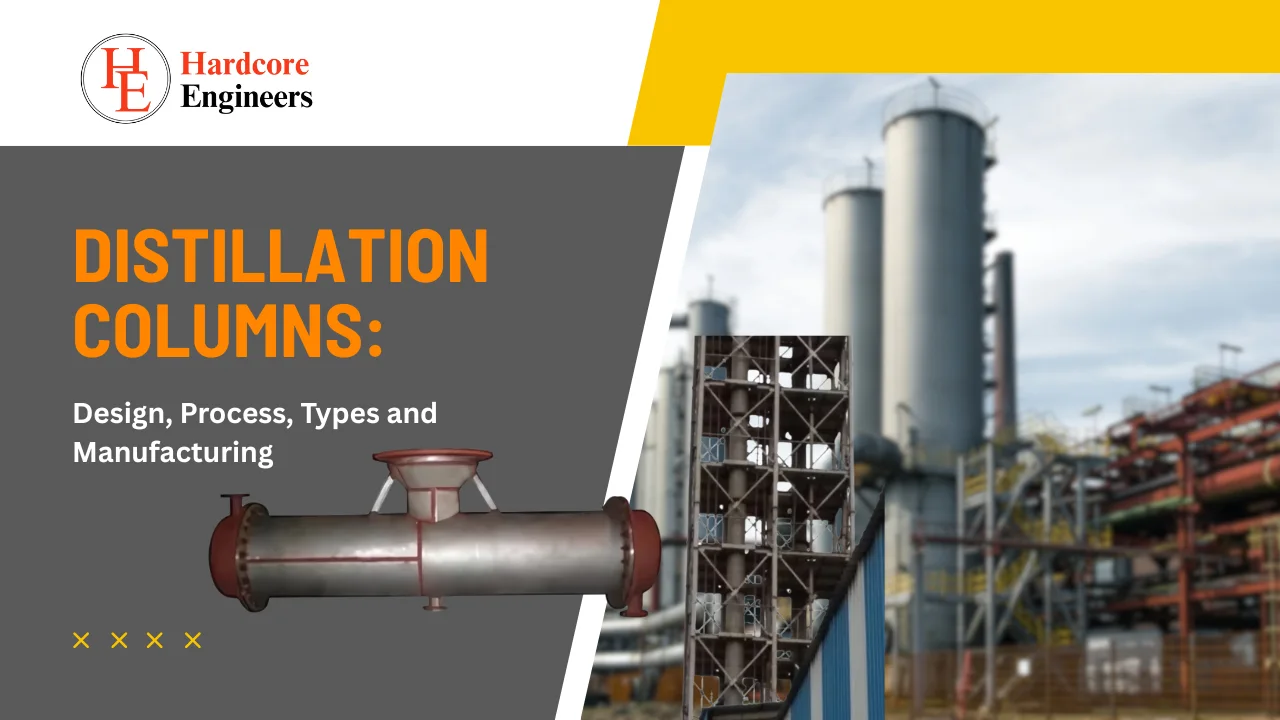
Distillation is one of the most widely used separation processes in the chemical, petrochemical, pharmaceutical, food, and refinery industries. In this process distillation column, a critical piece of equipment designed to separate liquid mixtures into their individual components based on differences in boiling points. From small-scale industrial units to large refineries, distillation columns play a vital role in ensuring product purity and process efficiency.
In this blog, we will explore distillation columns, their design principles, materials of construction, manufacturing considerations, and working mechanisms.
What Are Distillation Columns?
Distillation columns are vertical cylindrical vessels used to separate mixtures into two or more components using heat and mass transfer. The separation occurs when a liquid mixture is heated, causing components with lower boiling points to vaporize first. These vapors rise through the column, condense at different stages, and are collected as separate fractions.
Distillation columns are essential in industries where product quality, purity, and consistency are critical. Their performance directly impacts production efficiency and operating costs.
How Does a Distillation Column Work?
The process begins when a liquid mixture, known as the feed, is introduced into the column at a specific point. Heat is applied at the bottom of the column using a reboiler. As the mixture heats up, lighter components vaporize and move upward, while heavier components remain in liquid form and move downward.
As vapors rise, they encounter cooler surfaces or trays, where partial condensation occurs. This repeated vaporization and condensation process enhances separation efficiency. At the top of the column, lighter components are collected, while heavier fractions are drawn from the bottom.
This continuous interaction between vapour and liquid phases is what makes distillation columns highly effective separation tools.
Distillation Chamber: The Core of the System
The distillation chamber is the main body of the column where separation occurs. It houses internal components such as trays or packing, which increase the surface area for vapor-liquid interaction.
A well-designed distillation chamber ensures:
- Uniform flow distribution
- Minimal pressure drop
- Efficient heat transfer
- Enhanced separation performance
The design of the distillation chamber directly affects product purity and energy consumption. Precision engineering is essential to achieve optimal results, and this is where experienced manufacturers play a crucial role.
Types of Distillation Column
There are several types of distillation column, each designed for specific applications and process requirements.
1. Tray Distillation Columns
These columns use trays or plates arranged vertically inside the column. Vapors rise through openings in the trays, contacting the liquid on each level. Tray columns are commonly used in large-scale industrial operations due to their robustness and ease of maintenance.
2. Packed Distillation Columns
Packed columns are filled with structured or random packing material that provides a large surface area for vapor-liquid contact. They are ideal for applications requiring low pressure drop and high separation efficiency.
3. Batch Distillation Columns
Batch columns process a fixed quantity of feed at a time. They are commonly used in pharmaceuticals and specialty chemical industries where flexibility is important.
4. Continuous Distillation Columns
These columns operate continuously with constant feed and product withdrawal. They are widely used in petrochemical and refinery applications for large-volume processing.
Hardcore Engineers offer customized solutions across different types of distillation columns to meet diverse industry needs.
Design Considerations for Distillation Columns
Designing a distillation column requires careful consideration of multiple factors to ensure efficiency and safety.
Key design parameters include:
- Column diameter and height
- Number of trays or packing height
- Feed location
- Operating pressure and temperature
- Reflux ratio
- Material compatibility
A well-designed column minimizes energy consumption while maximizing separation efficiency. With strong engineering expertise, Hardcore Engineers focuses on delivering designs that balance performance, durability, and cost-effectiveness.
Materials Used in Distillation Columns
The choice of materials is critical in the manufacturing of distillation columns, as they must withstand high temperatures, pressures, and corrosive environments.
Common materials include:
- Stainless Steel (SS 304, SS 316): Widely used for corrosion resistance and hygienic applications
- Carbon Steel: Suitable for non-corrosive processes and cost-sensitive projects
- Alloy Steel: Used for high-temperature and high-pressure applications
- Special Alloys: For highly corrosive chemical environments
Manufacturing of Distillation Columns
The manufacturing process of distillation columns involves precision fabrication and strict quality control.
Key manufacturing steps include:
- Plate rolling and shell fabrication
- Welding and joint inspection
- Installation of trays or packing supports
- Surface finishing and testing
- Pressure and leakage testing
Experienced manufacturers ensure that each stage meets engineering and safety standards. Hardcore Engineers follow robust manufacturing practices to deliver high-quality distillation columns that perform reliably in demanding industrial environments.
Applications of Distillation Columns
Distillation columns are widely used across industries, including:
- Chemical and petrochemical processing
- Oil refineries
- Pharmaceutical manufacturing
- Food and beverage industries
- Solvent recovery systems
Their versatility and efficiency make them indispensable in modern industrial operations.
Why Choose Hardcore Engineers?
Hardcore Engineers is a trusted name in process equipment manufacturing, offering reliable and customized distillation column. We emphasize quality materials, precise engineering, and customer-focused design to deliver equipment that meets specific operational requirements.
By combining technical expertise with modern manufacturing capabilities, Hardcore Engineers ensures that its distillation columns deliver consistent performance, high efficiency, and long-term durability.
Conclusion
Distillation columns are the backbone of separation processes across numerous industries. Understanding how distillation columns work, Our design principles, materials, and manufacturing processes highlights their importance in achieving high-quality outputs. With expertly designed distillation chambers and multiple column types available, these systems continue to evolve with industry demands.
As industries grow and processes become more complex, well-engineered distillation columns will remain essential to modern manufacturing and processing systems.