
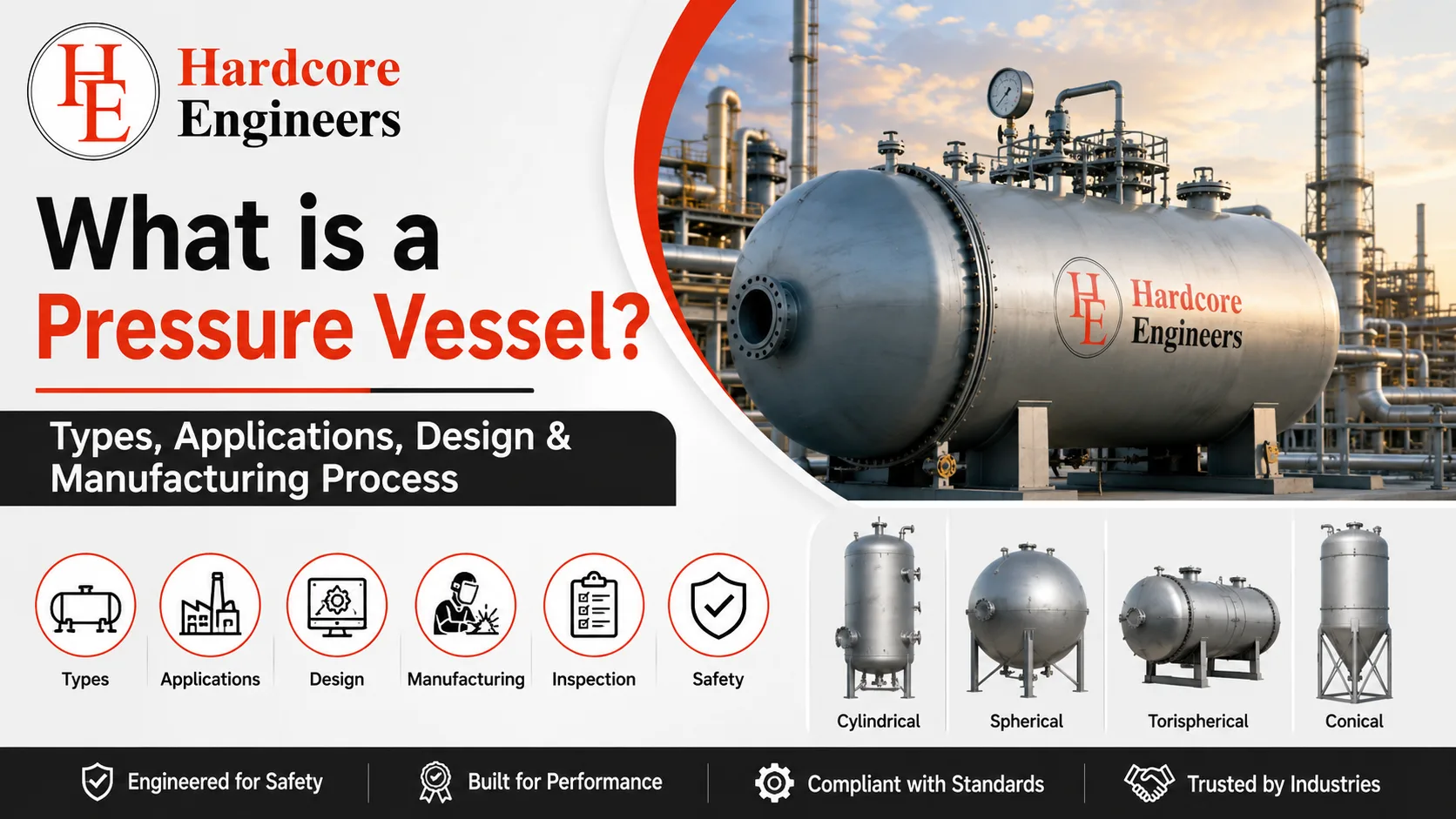
Pressure vessels are critical industrial equipment designed to safely store, process, or transport liquids and gases at pressures significantly different from ambient conditions. These vessels are widely used across industries such as oil & gas, chemical processing, power generation, pharmaceuticals, food processing, and water treatment.
Hardcore Engineers a well known manufacturer of pressure vessels, provides high-quality various types of vessels and also custom-engineered pressure vessels designed to meet demanding industrial requirements while ensuring safety, efficiency, and long-term reliability.
What is a Pressure Vessel?
A pressure vessel is a closed container specifically engineered to hold fluids or gases under pressure. Because pressure vessels operate under high internal or external pressures, they must be designed and manufactured according to strict engineering standards to ensure safe operation.
These vessels are commonly fabricated using carbon steel, stainless steel, alloy steel, and other specialized materials depending on the application and operating conditions.
Types of Pressure Vessels
Air Receiver Tanks
Air Receiver Tanks are pressure vessels used to store compressed air and maintain a consistent air supply within compressed air systems. These tanks help improve compressor efficiency, reduce pressure fluctuations, and support the operation of pneumatic tools and equipment in industrial facilities.
Storage Tanks
Storage Tanks are designed to safely store liquids, gases, and chemical substances under controlled conditions. These pressure vessels are widely used in oil & gas, petrochemical, water treatment, and manufacturing industries for bulk storage applications.
Separators
Separators are specialized pressure vessels used to separate gas, oil, water, and other fluids from a process stream. They play a critical role in oil and gas production by improving product quality and process efficiency.
Distillation Columns
Distillation Columns are vertical pressure vessels used to separate liquid mixtures into different components based on their boiling points. These vessels are extensively used in chemical processing, petroleum refining, and petrochemical industries.
Reactors
Reactors are pressure vessels designed to facilitate chemical reactions under controlled temperature and pressure conditions. They are commonly used in chemical manufacturing, pharmaceuticals, fertilizers, and petrochemical processing plants.
Heat Exchangers
Heat Exchangers are pressure vessels that transfer thermal energy between two or more fluids without mixing them. They are widely utilized in HVAC systems, power plants, refrigeration systems, and industrial processing applications.
Pressure Filters
Pressure Filters are vessels used for filtration processes where liquids or gases pass through filter media under pressure. These vessels are commonly employed in water treatment plants, pharmaceutical industries, and chemical processing facilities.
Surge Vessels
Surge Vessels are designed to absorb pressure fluctuations and protect piping systems from sudden pressure surges. They help maintain system stability and improve operational safety in fluid handling applications.
Expansion Tanks
Expansion Tanks are pressure vessels used to accommodate thermal expansion in closed-loop heating and cooling systems. They help maintain consistent system pressure and prevent equipment damage.
Vacuum Vessels
Vacuum Vessels are specially designed containers that operate under vacuum conditions. These vessels are commonly used in pharmaceutical, food processing, research laboratories, and industrial manufacturing processes.
Mixing Tanks
Mixing Tanks are pressure vessels equipped with agitators or mixers to blend liquids, chemicals, or other materials efficiently. They are widely used in chemical, food, beverage, pharmaceutical, and cosmetic industries.
Process Vessels
Process Vessels are custom-engineered pressure vessels used for various industrial operations such as mixing, separation, filtration, heating, cooling, and chemical processing. These vessels are designed according to specific process requirements and operating conditions.
Shapes of Pressure Vessels
Pressure vessels are manufactured in various shapes to meet different pressure, storage, and process requirements. The shape of a pressure vessel significantly influences its strength, efficiency, and application suitability.
- Cylindrical Pressure Vessels: The most commonly used design, ideal for storing liquids and gases under pressure.
- Spherical Pressure Vessels: Designed for high-pressure applications with uniform stress distribution and maximum strength.
- Ellipsoidal Pressure Vessels: Feature curved heads that provide excellent pressure resistance and structural stability.
- Torispherical Pressure Vessels: Equipped with dish-shaped heads, offering a balance between strength and economical manufacturing.
- Conical Pressure Vessels: Used where smooth material flow and discharge are required, particularly in processing industries.
- Horizontal Pressure Vessels: Installed horizontally for large-capacity storage and process applications.
- Vertical Pressure Vessels: Suitable for installations with limited floor space and various industrial processes.
Pressure Vessel Design Considerations
The design of a pressure vessel requires careful evaluation of operating conditions, safety requirements, and material properties to ensure reliable and long-term performance. Key design considerations include:
- Design Pressure: Maximum pressure the vessel is expected to withstand during operation.
- Design Temperature: Operating temperature range that affects material strength and vessel performance.
- Material Selection: Choosing suitable materials based on pressure, temperature, corrosion resistance, and process requirements.
- Wall Thickness: Calculated to safely withstand internal or external pressure loads.
- Corrosion Allowance: Additional thickness provided to compensate for material loss due to corrosion.
- Vessel Shape: Selection of cylindrical, spherical, vertical, or horizontal configurations based on application needs.
- Nozzle and Opening Design: Proper design of inlet, outlet, vent, and manway connections.
- Support Structure: Adequate support systems to handle vessel weight and operational loads.
- Safety Requirements: Integration of pressure relief valves and safety devices for safe operation.
- Inspection and Testing: Compliance with quality standards through hydrostatic testing, non-destructive testing (NDT), and final inspections.
A well-designed pressure vessel improves operational efficiency, enhances safety, minimizes maintenance requirements, and ensures long-term performance in industrial applications such as oil & gas, chemical processing, pharmaceuticals, power generation, food processing, and water treatment plants.
Pressure Vessel Manufacturing Process
The manufacturing of a pressure vessel involves a series of carefully controlled steps to ensure strength, safety, and reliability. The process typically includes:
- Design & Engineering – Preparation of vessel drawings and technical specifications.
- Material Selection – Choosing suitable materials based on pressure and temperature requirements.
- Cutting & Forming – Shaping metal plates into the required vessel configuration.
- Welding & Fabrication – Assembly of vessel components using approved welding procedures.
- Quality Inspection – Performing dimensional checks and non-destructive testing (NDT).
- Hydrostatic Testing – Testing the vessel under pressure to verify structural integrity.
- Surface Finishing – Applying protective coatings, painting, or polishing.
- Final Inspection & Dispatch – Ensuring compliance with quality standards before delivery.
A well-controlled manufacturing process ensures that pressure vessels deliver safe, efficient, and long-lasting performance in industrial applications.
Conclusion
Pressure vessels are indispensable components in modern industrial operations, providing safe storage and processing of gases and liquids under pressure. Proper design, material selection, and manufacturing practices are essential for ensuring safety and performance. With extensive expertise in pressure vessel fabrication, Hardcore Engineers delivers reliable, durable, and efficient pressure vessel solutions to the unique requirements of diverse industries.