
Distillation most widely used separation processes in chemical, petrochemical, pharmaceutical, and oil & gas industries. Distillation Column, a specialized equipment designed to separate liquid mixtures on different boiling points. These columns play a crucial role in refining, purification, and product recovery operations.
What is a Distillation Column?
A distillation column is a vertical vessel used to separate a liquid mixture into different components through repeated vaporization and condensation. The process relies on the principle that different substances have different boiling points. As the mixture is heated, lighter components vaporize and rise through the column, while heavier components remain lower in the system.
Distillation columns are widely used in industries where precise separation and purification are essential for product quality and process efficiency.
Distillation Chamber: The Core of the System
The distillation chamber is the main body of the column where separation occurs. It houses internal components such as trays or packing, which increase the surface area for vapor-liquid interaction.
A well-designed distillation chamber ensures:
- Uniform flow distribution
- Minimal pressure drop
- Efficient heat transfer
- Enhanced separation performance
The design of the distillation chamber directly affects product purity and energy consumption. Precision engineering is essential to achieve optimal results, and this is where experienced manufacturers play a crucial role.
Types of Distillation Columns
Different types of distillation columns are used depending on the separation requirements, production capacity, and process complexity.
1. Batch Distillation Column
In a batch distillation column, the feed mixture is charged into the column one batch at a time. Once the desired separation is achieved, the process is stopped, the products are collected, and a new batch is introduced. These columns are commonly used in pharmaceutical, specialty chemical, and small-scale production applications where flexibility is important.
2. Continuous Distillation Column
A continuous distillation column operates with a constant feed stream entering the system and continuous withdrawal of products. This type of column is ideal for large-scale industrial operations due to its high efficiency and uninterrupted production capability.
Continuous columns can be further classified into:
Binary Distillation Column: Designed to separate a feed mixture containing only two components. These columns are relatively simple and widely used in basic separation processes.
Multi-Component Distillation Column: Used when the feed contains more than two components. These columns perform complex separations and are extensively utilized in petroleum refineries, petrochemical plants, and large chemical processing facilities.
General Design Considerations for Distillation Columns
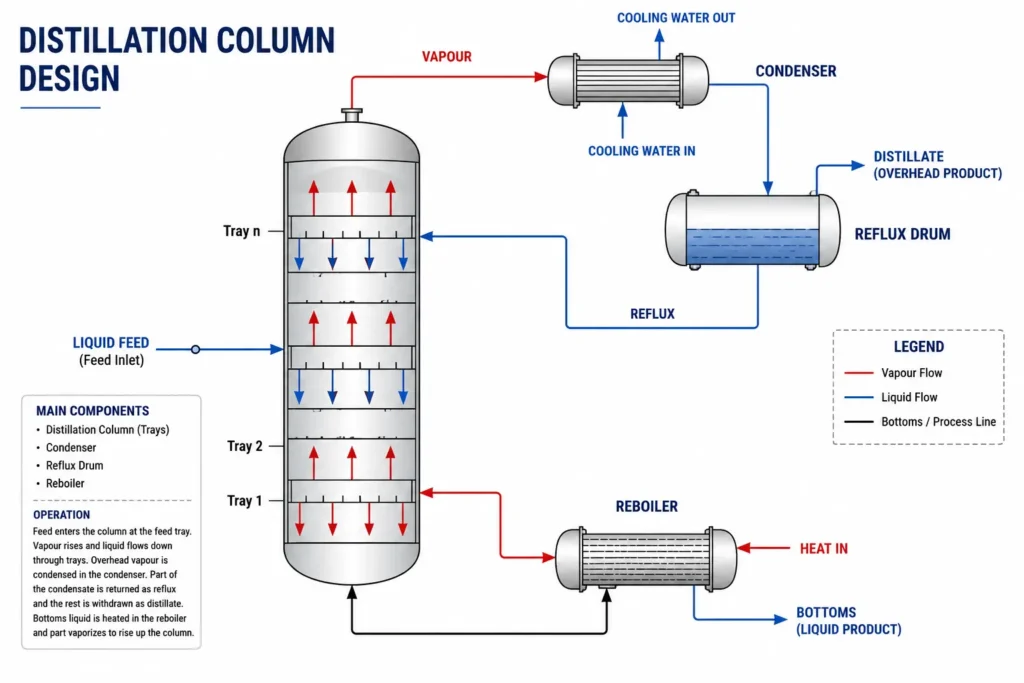
The design of a distillation column involves both process design and mechanical design to achieve efficient separation, operational reliability, and cost-effectiveness. Several factors must be considered during the design stage to ensure optimal column performance.
1. Feed Characteristics
The composition, flow rate, and physical properties of the feed mixture significantly influence the number of stages, operating conditions, and overall column design.
2. Operating Pressure and Temperature
Column pressure is typically determined by condenser cooling requirements and reboiler temperature limitations. Proper pressure and temperature selection ensures efficient separation and energy utilization.
3. Reflux Ratio
The reflux ratio plays a crucial role in determining separation efficiency and operating costs. An optimal reflux ratio is generally maintained slightly above the minimum requirement to achieve economical operation.
4. Column Dimensions
The column diameter and height are designed based on vapor and liquid traffic, required separation efficiency, and production capacity while ensuring stable operation.
5. Tray or Packing Selection
The choice between trays and packing depends on process requirements, pressure drop limitations, efficiency targets, and maintenance considerations.
6. Safety and Structural Requirements
Proper safety factors, material selection, wind load considerations, maintenance accessibility, and compliance with industry standards are essential for reliable long-term operation.
Distillation Column Internal Components
The efficiency of a distillation column depends largely on its internal components, which facilitate effective vapor-liquid contact and separation.
1. Trays
Trays are horizontal plates installed inside the column to promote interaction between rising vapor and descending liquid. They improve mass transfer and enhance separation efficiency. Common types include sieve trays, valve trays, and bubble cap trays.
2. Packing
Packing materials provide a large surface area for vapor-liquid contact within the column. They are commonly used in packed columns and are available as random packing or structured packing, offering improved efficiency and lower pressure drop.
3. Reboiler
Located at the bottom of the column, the reboiler supplies the heat required for the distillation process. It vaporizes part of the liquid, generating the vapor that rises through the column and drives separation.
4. Condenser
The condenser is installed at the top of the column and cools the vapor exiting the system. It converts the vapor back into liquid, allowing part of it to be collected as the final product while the remainder is returned as reflux to improve separation performance.
Materials Used in Distillation Columns
The choice of materials is critical in the manufacturing of distillation columns, as they must withstand high temperatures, pressures, and corrosive environments.
Common materials include:
- Stainless Steel (SS 304, SS 316): Widely used for corrosion resistance and hygienic applications
- Carbon Steel: Suitable for non-corrosive processes and cost-sensitive projects
- Alloy Steel: Used for high-temperature and high-pressure applications
- Special Alloys: For highly corrosive chemical environments
Manufacturing of Distillation Columns
The manufacturing process of distillation columns involves precision fabrication and strict quality control.
Key manufacturing steps include:
- Plate rolling and shell fabrication
- Welding and joint inspection
- Installation of trays or packing supports
- Surface finishing and testing
- Pressure and leakage testing
Experienced manufacturers ensure that each stage meets engineering and safety standards. Hardcore Engineers follow robust manufacturing practices to deliver high-quality distillation columns that perform reliably in demanding industrial environments.
Applications of Distillation Columns
Distillation columns are widely used across industries, including:
- Chemical and petrochemical processing
- Oil refineries
- Pharmaceutical manufacturing
- Food and beverage industries
- Solvent recovery systems
Their versatility and efficiency make them indispensable in modern industrial operations.
Why Choose Hardcore Engineers?
Hardcore Engineers is a trusted name in process equipment manufacturing, offering reliable and customized distillation column. We emphasize quality materials, precise engineering, and customer-focused design to deliver equipment that meets specific operational requirements.
By combining technical expertise with modern manufacturing capabilities, Hardcore Engineers ensures that its distillation columns deliver consistent performance, high efficiency, and long-term durability.
Conclusion
Distillation columns are the backbone of separation processes across numerous industries. Understanding how distillation columns work, Our design principles, materials, and manufacturing processes highlights their importance in achieving high-quality outputs. With expertly designed distillation chambers and multiple column types available, these systems continue to evolve with industry demands.
As industries grow and processes become more complex, well-engineered distillation columns will remain essential to modern manufacturing and processing systems.