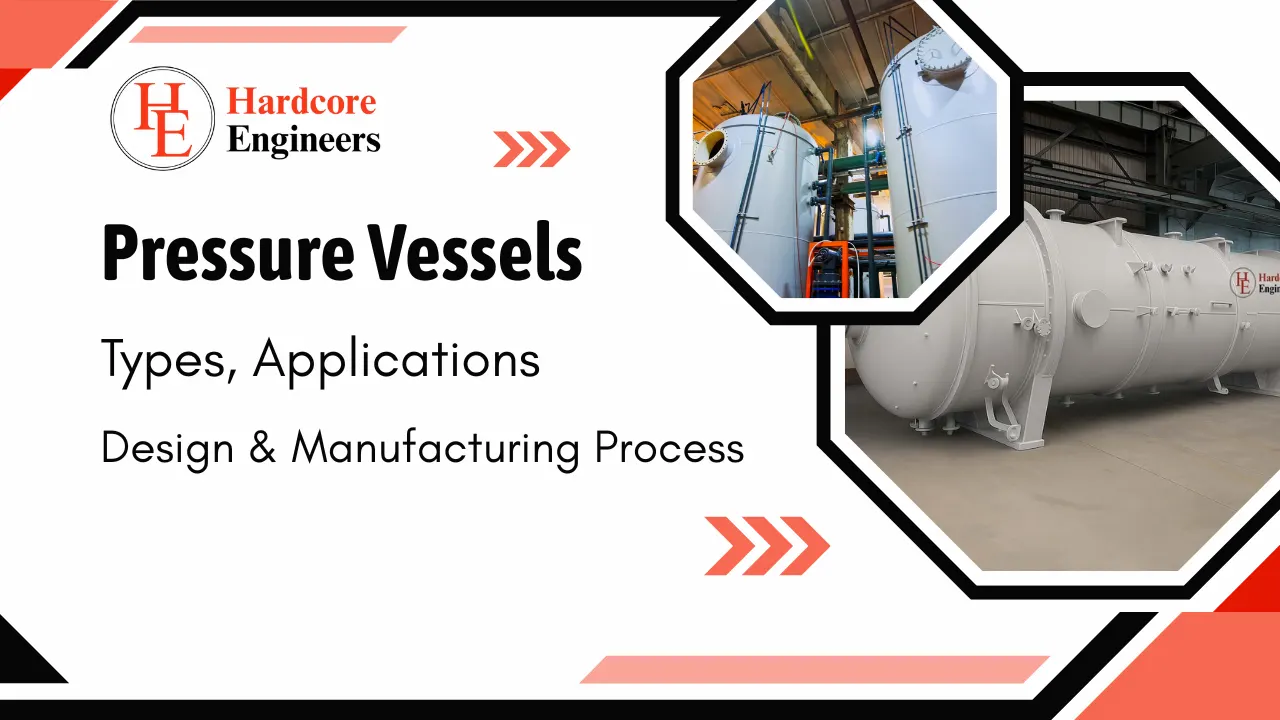
Pressure vessels are critical industrial equipment designed to store or process fluids under pressure. They are widely used across industries such as power generation, chemical processing, oil & gas, pharmaceuticals, food processing, and manufacturing. Understanding the basics of pressure vessels, their types, design principles, and manufacturing process is essential for ensuring safety, efficiency, and long service life.
Hardcore Engineers provides you with an essential guide on pressure vessels, covering everything from basic concepts and types of pressure vessels to their applications, pressure vessel design principles, and manufacturing processes.
What Is a Pressure Vessel?
A pressure vessel is a closed container designed to hold gases or liquids at a pressure significantly different from ambient pressure. Due to the high-pressure conditions involved, proper engineering design and precise manufacturing are crucial to prevent failures and ensure safe operation.
Pressure vessels can vary in size, shape, and application depending on industry requirements. Hardcore Engineers specializes in designing and manufacturing reliable pressure vessel tanks for diverse industrial needs.
Types of Pressure Vessel
Pressure vessel types are classified based on their shape, orientation, and application. Each type is designed to withstand specific pressure, temperature, and operating conditions. Hardcore Engineers manufacture different types of pressure vessels to meet diverse industrial requirements.
Horizontal Pressure Vessels
Horizontal pressure vessels are widely used in industries where large volumes of liquid or gas need to be stored or processed. These vessels are installed horizontally on saddle supports, which provide excellent stability and load distribution. Due to their design, horizontal pressure vessels are easy to inspect, clean, and maintain, making them ideal for continuous industrial operations. They are commonly used in oil and gas separation units, chemical storage systems, and fuel storage applications.
Vertical Pressure Vessels
Vertical pressure vessels are preferred in applications where floor space is limited and height is available. These vessels are mounted vertically using legs, skirts, or lugs and are suitable for processes that require gravity-assisted flow. Vertical pressure vessels are commonly used in reactors, boilers, distillation columns, and chemical processing units. Their design allows efficient handling of pressure and temperature variations while enabling effective fluid drainage.
Cylindrical Pressure Vessels
Cylindrical pressure vessels are the most commonly used type due to their simple design, cost-effectiveness, and ease of fabrication. The cylindrical shape provides uniform stress distribution along the shell, making it suitable for a wide range of pressure and temperature conditions. These vessels are widely used as air receivers, storage tanks, heat exchangers, and process vessels in various industries.
Spherical Pressure Vessels
Spherical pressure vessels are designed to store fluids at very high pressure, as their shape allows even distribution of stress in all directions. This design minimizes material usage while maximizing strength and safety, making spherical vessels ideal for storing pressurized gases. They are commonly used for LPG storage, chemical gas storage, and petrochemical applications. Due to their complex fabrication and installation, these vessels require high engineering precision.
Low-Pressure and High-Pressure Vessels
Pressure vessels can also be classified based on operating pressure. Low-pressure vessels are used in applications such as water storage, air handling systems, and low-pressure processing units, where safety requirements are less demanding. High-pressure vessels, on the other hand, are designed to withstand extreme pressure and temperature conditions found in chemical processing, power plants, and oil and gas industries.
Jacketed Pressure Vessels
Jacketed pressure vessels are designed with an outer shell or jacket that surrounds the main vessel, allowing heating or cooling of the internal contents. This design is essential in processes where temperature control plays a critical role, such as chemical reactions, pharmaceutical manufacturing, and food processing. Jacketed vessels improve process efficiency by maintaining uniform temperature and preventing overheating or cooling losses.
Applications of Pressure Vessels
Pressure vessels are used in a wide range of industrial applications, including:
- Chemical and petrochemical plants
- Oil and gas processing units
- Power plants and boilers
- Pharmaceutical manufacturing
- Food and beverage processing
- Air receivers and storage tanks
Pressure Vessel Design
Pressure vessel design is one of the most critical aspects of manufacturing. It involves detailed calculations to withstand internal and external pressure, temperature, corrosion, and mechanical loads.
Key factors considered in pressure vessel design include:
- Operating pressure and temperature
- Material selection
- Vessel shape and thickness
- Welding methods and joint efficiency
- Safety factors and industry codes (such as ASME standards)
We follow proven engineering practices and recognized design codes to ensure safe and durable pressure vessels.
Manufacturing Process of Pressure Vessels
The manufacturing of pressure vessels involves several controlled steps to ensure quality and safety:
- Material Selection: High-grade carbon steel or stainless steel based on application
- Plate Cutting & Forming: Rolling and shaping the vessel shell
- Welding: Precision welding using certified procedures
- Heat Treatment: Stress relieving when required
- Non-Destructive Testing (NDT): Radiography, ultrasonic, and pressure testing
- Surface Finishing & Coating: Protection against corrosion
At Hardcore Engineers, every pressure vessel tank undergoes strict quality inspection and testing before delivery.
Conclusion
Pressure vessels play a vital role in modern industrial operations, requiring expert design, high-quality materials, and precision manufacturing. From selecting the right types of pressure vessels to ensuring safe pressure vessel design and reliable fabrication, each step is crucial.
With strong engineering expertise and commitment to quality, Hardcore Engineers delivers durable, efficient, and safe pressure vessel tanks tailored to meet diverse industrial requirements.